

 Article
  Digital download
  Guide
Guide  Podcast
  Video
Video Breaking weight loss plateaus: The metabolism reset method
You’ve been working hard, embracing healthier eating habits, and seeing incredible progress on your weight loss journey. Then, suddenly, the numbers on the scale stop moving. This frustrating experience is known as a weight loss plateau.
Many people encounter this hurdle, which can lead to demotivation. But a weight loss plateau isn’t a sign of failure; it’s a natural and often necessary part of your body’s adaptation, a crucial step towards sustainable weight loss. The key to moving past it isn’t to work harder, but to work smarter by understanding and optimizing your metabolism.
In this comprehensive guide, we’ll explore why weight loss plateaus occur, delve into the science of metabolic flexibility, and provide actionable strategies to reset your metabolism. We’ll show you how understanding your body’s unique energy needs, with the help of tools like Lumen, can empower you to break through stagnant weight loss.
Understanding your weight loss plateau: a natural adjustment
A weight loss plateau occurs when you stop losing weight for an extended period despite maintaining consistent exercise and healthy dietary habits. It’s a common and natural part of the process, not a sign that you’re doing something wrong. Think of it as your body taking a moment to catch up and recalibrate.
When you initially lose weight, your body undergoes significant changes. As you shed pounds, your metabolic rate can naturally decrease because a smaller body requires fewer calories to maintain itself. Your body also becomes more efficient at using energy, burning fewer calories for the same activities. This adjustment is a healthy response, not a bad one. While frustrating, this period of stagnation is crucial for sustainable weight loss, allowing your body to stabilize before further progress.
The key to progress: boosting your metabolic flexibility
To effectively break a weight loss plateau, you need to optimize your metabolic flexibility. But what exactly is metabolic flexibility? Simply put, it’s the ability of your mitochondria, the powerhouses of your cells, to efficiently shift between burning fat and carbs for energy.
When you’re metabolically inflexible, your body gets “stuck” in one gear, often preferring to burn carbohydrates even when fat stores are abundant. For individuals dealing with stagnant weight loss, especially those who are obese, improving metabolic flexibility is paramount. It’s the key to maximizing fat burn and using carbs for energy, rather than storing them as fat.
This is where Lumen comes in. By measuring your metabolism through your breath, Lumen provides daily lifestyle strategies and AI health coaching to optimize your metabolic flexibility, including personalized nutrition plans, carb recommendations, and macro tracking.
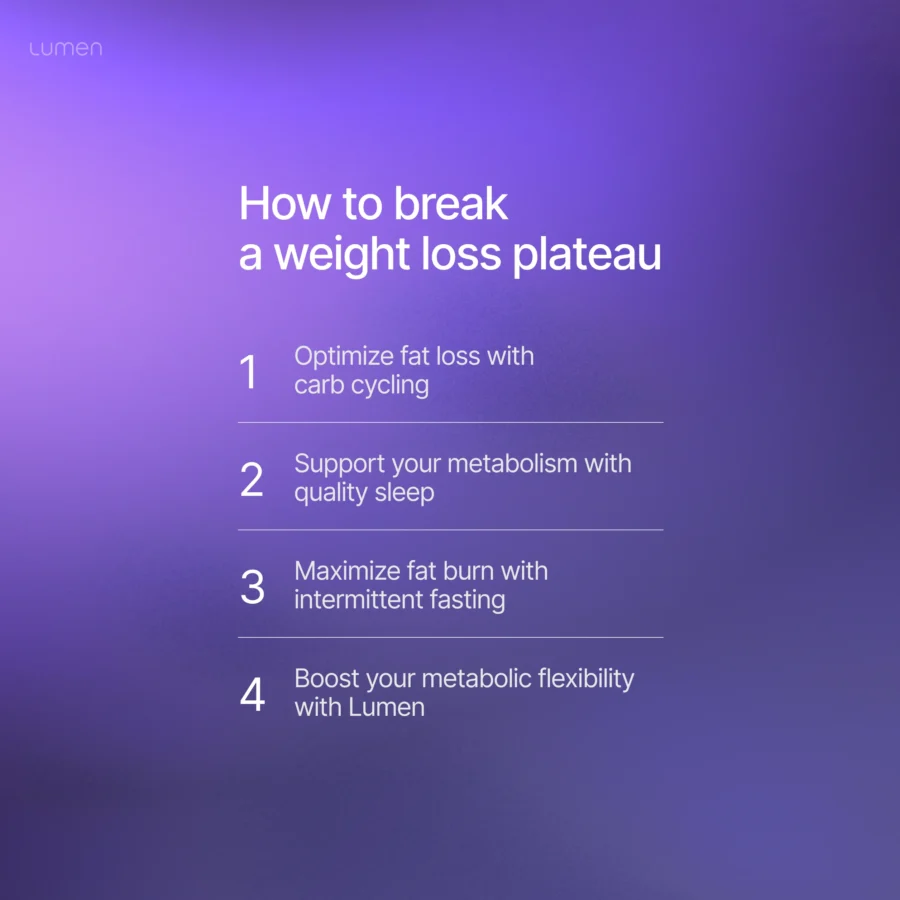
Strategy 1: Optimize fat loss with carb cycling
Carb cycling is an effective dietary strategy to optimize fat loss and enhance metabolic flexibility. It involves varying your carbohydrate intake, alternating between high-carb and low-carb days.
Here’s how it works:
Low-carb days: On these days, you significantly reduce your carbohydrate intake. This depletes your body’s glycogen stores (stored carbs), encouraging your body to rely on fat as its primary energy source. This shift promotes greater fat oxidation and trains your body to become more efficient at burning fat.
High-carb days: These days involve a higher intake of carbohydrates. This helps to replenish glycogen stores, which can be beneficial for muscle recovery, hormone regulation, and preventing metabolic slowdown that can sometimes occur with prolonged low-carb diets.
Cycling through low- and high-carb intake promotes better metabolic flexibility by regularly challenging your body to switch between fuel sources. It teaches your metabolism to be agile, making it easier to tap into fat stores when needed.
How Lumen helps: Lumen can be an invaluable tool for carb cycling
Measuring your metabolism in the morning provides you with a personalized nutrition plan for the day based on your results, guiding you on whether to eat low, medium, or high carb.
What’s more, by measuring your metabolism before eating, you can figure out if you should have a low- or high-carb meal.
If you’re burning carbs, then Lumen recommends a low-carb meal. If you’re burning fat, Lumen will suggest a high-carb meal.
Strategy 2: Support your metabolism with quality sleep
The importance of sleep for overall health is well-documented, but its profound impact on metabolic health and weight loss is often underestimated. Poor sleep quality could be a significant, yet overlooked, factor in a weight loss plateau.
Insufficient sleep disrupts the delicate balance of hormones that regulate hunger and satiety. Specifically, it can increase levels of ghrelin, the “hunger hormone,” and decrease levels of leptin, the “satiety hormone.” This hormonal imbalance can lead to increased cravings, particularly for high-carb and high-fat foods, and drive up food intake, making it harder to stick to your dietary goals [1].
Furthermore, lack of quality sleep negatively affects insulin sensitivity [2]. When your body’s cells become less responsive to insulin, it impairs their ability to process glucose efficiently. This can lead to higher blood sugar levels and an increased risk of fat storage, especially around the abdomen.
Getting 7-9 hours of quality sleep each night is crucial for metabolic health. It helps your body shift from carb burn to fat burn overnight, which significantly boosts metabolic flexibility. During deep sleep, your body prioritizes repair and recovery, and your metabolism naturally shifts towards using fat for energy.
Tips for quality sleep:
- Eat your carbs in the first half of the day
- Have an earlier dinner
- Avoid bright screens before bed
- Create a relaxing bedtime routine
How Lumen helps: Lumen can provide insights into how your sleep impacts your morning metabolic state
A consistent pattern of good sleep often correlates with waking up in fat burn, indicating metabolic flexibility. By tracking your morning fat burn alongside your sleep habits, you can identify patterns and make adjustments to optimize your sleep for better metabolic health.
Strategy 3: Maximize fat burn with intermittent fasting
Intermittent fasting (IF) is a powerful strategy that can significantly improve metabolic flexibility and help you shed pounds, allowing you to overcome plateaus more effectively. Rather than focusing on what to eat, IF focuses on when to eat.
During fasting, your body undergoes a metabolic shift. Initially, it uses glucose (sugar) as its primary energy source. Once that’s depleted, it moves on to glycogen, our bodies’ carb stores, primarily in the liver and muscles. As these glycogen stores become depleted, your body starts breaking down stored body fat to use as energy. This process is a powerful way to increase fat burn and contributes to metabolic flexibility [3].
Intermittent fasting trains your body to become more adept at accessing and using its fat reserves. This is particularly beneficial for individuals with stagnant weight loss, as it provides a consistent stimulus for fat oxidation and acts as a metabolic flip switch.
Common intermittent fasting methods include:
- 16/8 method
- 18/6 method
- OMAD (one meal a day)
It’s important to start gradually and listen to your body. Ensure you stay hydrated during fasting periods and consume nutrient-dense foods during your eating windows.
How Lumen helps: Lumen helps you find your perfect fasting window
Lumen can show you when your body shifts from burning carbs to burning fat. This real-time feedback confirms that your fasting efforts are effectively moving you into a fat-burning state.
Lumen can also help you determine exactly how long to fast for your body to maximize fat burn and avoid muscle breakdown. It does this by identifying when your body shifts from burning fats to carbs during your fast. That means your glycogen stores are critically low, you’ve reached your fasting sweet spot, and should break your fast and eat something nutritious.
Power your metabolism, break the plateau
Encountering a weight loss plateau can be disheartening, but it’s a normal and healthy part of sustainable weight loss.
By focusing on optimizing your metabolic flexibility through strategies like carb cycling, prioritizing quality sleep, and intermittent fasting, you can gently nudge your body out of the plateau. These aren’t just quick fixes; they are sustainable lifestyle adjustments that foster long-term metabolic health.
Remember, your body is adaptable. With consistent effort, patience, and the right tools, you can reset your metabolism and continue making progress toward your health and weight loss goals.
FAQs
Q: What exactly is a weight loss plateau?
A: A weight loss plateau occurs when your body stops losing weight for an extended period (typically several weeks) despite maintaining consistent healthy eating and exercise habits. It’s a natural adaptation as your body adjusts to its new weight.
Q: How does metabolic flexibility help break a plateau?
A: Metabolic flexibility is your body’s ability to efficiently switch between burning fat and carbs for energy. By improving this flexibility, your body becomes better at tapping into fat stores, which is crucial for overcoming stagnant weight loss.
Q: Is carb cycling safe for everyone?
A: Carb cycling is generally safe for most healthy individuals. However, it’s always advisable to consult with a healthcare professional or a registered dietitian before making significant changes to your diet, especially if you have underlying health conditions.
Q: How long does it typically take to break a weight loss plateau?
A: The time it takes to break a plateau varies from person to person, depending on individual metabolism, consistency of effort, and lifestyle strategies. It could take a few weeks to a couple of months. Patience and continuously adapting metabolic-boosting strategies are key.
Q: Can Lumen really help me understand my metabolism better?
A: Yes, Lumen provides real-time breath analysis to show you whether your body is primarily burning carbs or fat. This daily insight tailors your nutrition plan, provides metabolic insights, and helps you track the impact of your food, sleep, and activity choices, so you can make informed decisions to improve your metabolic flexibility and break through plateaus.
Sources
[1] Spiegel, K., Tasali, E., Penev, P., & Van Cauter, E. (2004). Brief communication: Sleep curtailment in healthy young men is associated with decreased leptin levels, elevated ghrelin levels, and increased hunger and appetite. Annals of internal medicine, 141(11), 846–850. https://doi.org/10.7326/0003-4819-141-11-200412070-00008
[2] Sondrup, N., Termannsen, A. D., Eriksen, J. N., Hjorth, M. F., Færch, K., Klingenberg, L., & Quist, J. S. (2022). Effects of sleep manipulation on markers of insulin sensitivity: A systematic review and meta-analysis of randomized controlled trials. Sleep medicine reviews, 62, 101594. https://doi.org/10.1016/j.smrv.2022.101594
[3] Marko, D. M., Conn, M. O., & Schertzer, J. D. (2024). Intermittent fasting influences immunity and metabolism. Trends in endocrinology and metabolism: TEM, 35(9), 821–833. https://doi.org/10.1016/j.tem.2024.04.014
Disclaimer
The information provided here is strictly informational and educational. It does not serve as medical advice or a health assessment and is not intended to diagnose, treat, cure, or prevent any disease. Consult with your healthcare professional before making any significant changes to your diet or exercise routine.
 Copy article text
Copy text 

Our Lumen editorial desk includes an in-house team of certified and registered nutritionists and dietitians, scientists, researchers, and writers.
See all articles